Why Women Experience More Chronic Pain: What New Science Says
If you've ever been told your pain is "stress" or "all in your head," you're not alone. Women are far more likely to live with chronic pain, and for a long time, no one could fully explain why. A new review in Science (October 2026) is changing that. If you would like to read the study, please click the button above for access. I didn’t want to use links as those can expire or become corrupted.
The Numbers Are Striking
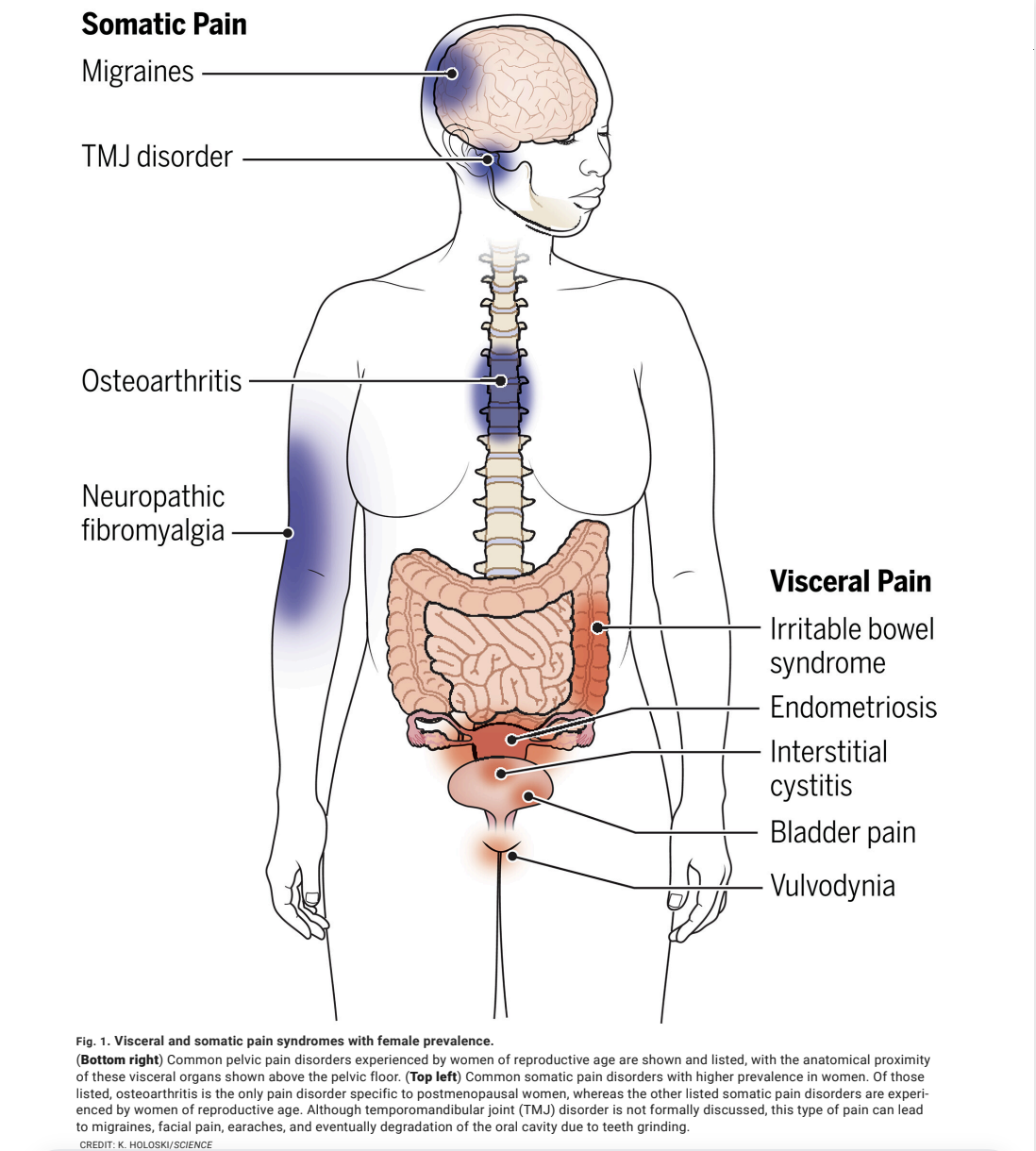
Women develop functional pain disorders at about twice the rate of men, and the ratio can climb much higher in some conditions. These include irritable bowel syndrome (IBS), endometriosis, interstitial cystitis, vulvodynia, menstrual migraine, fibromyalgia, and osteoarthritis. The authors point to a gap between public awareness of women's pain and the research aimed at treating it.
Hormones Are Part of the Story
If you’re over 30, you know I always mention hormones at some point during our session. I know it might sound odd to discuss during a massage but hormones play a huge role in your overall wellness.
Researchers found that the fluctuation of ovarian hormones, beginning at puberty, appears to start many female-prevalent pain conditions. For example
Women with IBS show clear changes in gut pain sensitivity across the menstrual cycle. Healthy controls don’t have these changes.
Pelvic pain in endometriosis often intensifies during menstruation.
Menstrual migraines tend to peak just before or during menses, and they ease in the second and third trimesters of pregnancy.
Osteoarthritis risk rises as women age and estrogen declines. In the knee, rates can be twice those of men.
The Immune System and Gut Matter Too
Pain is not only a nerve signal. In animal studies, males and females relied on different immune pathways to develop nerve pain. Males leaned on spinal microglia, while females relied more on T cells. Females also appear to have a built-in pain-relief system. Regulatory T cells, supported by ovarian hormones, release a natural opioid-like compound called enkephalin. So, if you’re female, it’s not all in your head, pain is experienced differently in your body compared to males.
The gut microbiome plays a role as well. It helps regulate hormone availability, and in mice, removing the microbiota erased the changes in gut sensitivity linked to the hormone cycle. This is why I ask “how’s your eating?” It can paint a picture of how your GI system is doing today. Maybe instead of a full body massage, we forgo an area and spend time on an abdominal massage.
Pain also tends to resolve more slowly in women, and researchers linked this to lower levels of an anti-inflammatory signal called IL-10
Why This Matters for You
The authors hope this work will help end the "all in your head" response, shorten the long wait between symptoms and diagnosis, and lead to treatments based on mechanisms. Much of this research is early and done in animals, so it doesn't yet change what any one person should do. But it confirms something many clients already know: your pain is real, and it has biology behind it.
Ready to Feel Heard in Your Body?
If you live with chronic pain and want care that listens first, book a session or reach out with questions. We'll shape the session around you.
This article is educational and not medical advice. Findings described come largely from preclinical studies. Source: Venkataraman A., Midavaine É., Ingraham H.A. "Sex-specific mechanisms of chronic pain." Science 394(6819), 2026. DOI: 10.1126/science.aeh4468.